Friday, May 10, 2013

My Kingdom for a Shitbox

Anyone who has spent anytime within earshot of me knows that I spend a lot of money on gasoline.  Subsequently, I've been thinking seriously of trading down to something that burns less (both in gas and liability insurance), preferably at a lower octane.  

But, things have changed in the last 15 years or so.  All the cars I was hoping to trade down into are gone. The shitbox, as an automotive institution has all but vanished from the road, and I am sad.

Maybe I should define my terms.  Many years ago, car manufacturers' entry level vehicles were small, light, unremarkably-styled, spartan in appointments, and literally cheaper than dirt.  These vehicles largely made no attempt to disguise the modesty of their design parameters; 13-inch steel wheels, manual-everything, with both carpeting and radio appearing on the "options" list. They were unpretentious.  They were practical.  They were shitboxes.  

I don't know whether the culprit is our own dishonestly optimistic consumer taste at the national level, exponentially increasing safety standards or things just "getting better", but now, even the basest of the base so-called sub-compact comes with chrome, 19-inch drug-dealer wheels,  8-speed, paddle-shifted, smarter-than-you automatics and....I dunno...blue-tube or whatever.

James May, reviewing the second generation Fiat Panda, described the attitude of the car as simply saying, "Look--I'm a cheap, little car.  Let's just get on with it."  Historically, the US has been a much smaller market for these cars (we never even got the Panda), but there was a time, not so long ago that cheap, wonderful shitboxes could be found for a pittance in the free-ads at every corner market.  

The following is a short list of cars I was hoping to find for sale (or at least find one on the street to photograph instead of stealing from the internet).  No dice.

Subaru Justy 

"Hey, ladies!"  

Subaru has now effectively cornered the market on granola-and-sandals parents, but before Fuji-Heavy Industries had ever heard of "branding" they were trying to sell cars to every Tom, Dick and Hitoshi. They even  made three-doors with non-mandatory 4WD.  Look how happy this guy is!


Ford Festiva
"I've really made it!"

Not to be confused with the Ford Fiesta, which is, by all rights an actual "cool car," with modern styling and creature comforts.  Ford used to import a little Korean shit-box which shared the Japanese car-naming tendency of using "almost a real word."

Toyota Corolla FX

"I fit inside my car.  Today was a good day."
In the late 1970's, the Corolla was available in seven body configurations.  Today it's available in one, and that one is fucking terrible.  The FX had a dramatically different look from the rest of the Corollas in the line, taking a cue from AMC's let's-just-chop-its-butt-off-and-call-it-a-day design philosophy, used to such great effect on the Gremlin.

Anyway, I'm at an impasse.  The cars I want were all crushed into salvage steel, when I wasn't paying attention.  I guess the used Hyundai Accents I see everywhere meet the criteria of being thrifty and unaffected in character...But there is a difference between a good-quality shitbox and just an actual piece of shit.


Thursday, April 25, 2013

Fashion Thursday with Juvenile Hobo Matlock


I found this mildly shocking (and I realize that sounds oxymoronic):
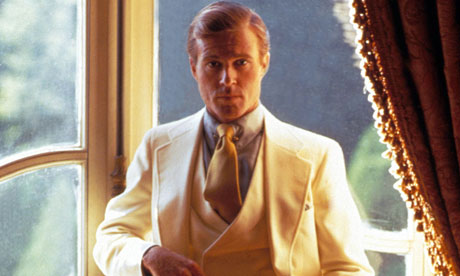
Brooks Brothers now has a "Gatsby Collection".


Subtle.

Side-note:  This has nothing to do with anything, but I love the fashion anachronism inherent to shooting something taking place way-back-when.  I mean, take a look at both films, the Robert Redford and the DeCaprio versions, and you'll see two wardrobes that have only color palette in common, and even less in common with the era they inhabit.   Although, I'll warrant,  since we're stuck in 2013, the 1974 release seems much more egregious, with its feathered hair,  ties + lapels 5-inches wide and --of course-- bell-bottoms.


"Who'd have thought my 'Midnight Cowboy' outfit would age better?"

But I digress.

Brooks Brothers???  Really?  Aren't they supposed to be the stodgy, olde-guarde clothier, contemptuous of fleeting, flavor-of the-week stunts like this?  Movie merchandising tie-ins always smell faintly of Burger King to me, but, of course, I am a completely out-of-touch, toothless, old fuddy-duddy, who understands nothing about marketing, and even less about successful marketing.

Okay, so there is well-received retail precedent established for this:  You might remember the most recent and recognizable example was the "Mad Men" collection at Banana Republic.  And that totally makes sense for GAP's higher-shelf-yet-miles-from-aspirational brand.  You won't find anyone in their customer demographic charts who'll scoff at clothing developed from a television series, even if it is on AMC.

Perhaps even more importantly, by the time the "Mad Men" line was launched, the wardrobe from the show didn't differ drastically from what folks were wearing in the main'est of streams--just give your models some John Hamm hair, throw on some of the same damn grey suits and shawl-cardigans you were already selling, and call it a day.  Jackpot.


Basically...these are clothes.

But the "Gatsby Collection?"   Peaked-lapels on a pin-striped pink linen suit?  Who has the balls to wear that?  It's one thing to pay some marketing flunkies to breathe on your ads to pedal some shit that's basically indistinguishable from what's already on the rack, but this?  Some of this stuff is downright camp  (Not that there's anything wrong with that!) But are the rank and file BB shoppers going to drop 800 bucks for a something so farcical as a violently red, white and blue regatta blazer?  


"All ready for that job interview /Grampa's funeral!
Maybe I'm totally wrong though.  

Go big or go home, right?  <belch>  'Merica.  

Maybe the irony of the age of #menswear is that wearing a suit made of grey flannel doesn't read as fundamentally different from one of pink linen.  You're still "trying too hard." Sometimes, it seems like if you bother to button your fly, pick the french fries out of your hair and wear something aside from the silicon valley hoodie and plaid shorts, you may as well carry a sign that says "I FIND YOUR ATTIRE AND SEXUAL ORIENTATION HOPELESSLY UNIMAGINATIVE." Is there a hashtag for menswearbacklash yet?

Example: here's a conversation I had with an undergrad engineering student at a pretty fucking terrible party little while back:

"What, are you an artist?"
"No, I'm the opposite of that; I'm an engineer."
"Oh.  Well, you dress like an artist."
"Oh.  I don't know what that means."
"I hate artists."
"Okay, cool."

And, scene.

Is the implication that if I were to wear a dumpy, over-sized  T-shirt, prominently advertising a defunct software product and sweatpants covered with ejaculate stains, then and only then, would I be certifiably "dressed like an engineer"?  

I guess that's more or less true today, which is odd, because back when dress codes existed, "the engineer style" meant something entirely different; it referred to the logical conclusion attained from attempting to meet the bare minimum qualifications for said dress code, with short sleeves and a tie-clip to reduce interference with the ol' drafting table.  The best documented, pop-culture example of this has become Micheal Douglas's character, "D-Fens," in "Falling Down." 
Those Aero guys are notoriously high-strung.  

By the way, this is what happens when you take away the dress code and turn an engineer loose in retirement.  


Dad's not prone to taking "fashion tips" from anyone.

...


...


...

Oh, right--Brooks Brothers!  I don't have the guts or the cash for the collection, but I hope they find some buyers who do.  

And I'm working on the guts part.  In fact, it's getting so hot, I finally broke down and bought a linen suit. 


Yes, I did.
It's a new thing for me, and a bit more flamboyant than what I usually wear, but I'm hoping it won't be entirely incongruent with my earlier precedent of dress:  still conservative tones, and still covered in filth, but with a bit more Matlock...and younger, I guess?  

I will wear this out.  And people will ask why I'm so dressed-up. And, as always, I will shrug, look at the floor and say that I just didn't have time to change after work, as if that answers the question.


Saturday, April 13, 2013

Bachelor of Science Degrees and Other Types of Magic Beans


So, I've been seeing this article, by a Michell Arnold, ricocheting about the internet quite a bit during the last week. It isn't the worst-written piece I've ever read on the subject of post-collegiate poverty and student loan enslavement, but...actually, yes. Yes it is, hands-down.  But, be that as it may, I do agree with the premise that student loan dept is a huge problem, and I'm actually on board with the legislation that's been recently proposed, such as The Student Loan Fairness Act (H.R. 1330). I still have a pretty decent pile of college dept myself, so I share the same basic bias and bitterness as the demographic that the piece supposedly represents.  However.  The resurgence of this discussion reminds me that, as a culture, we're still fundamentally looking at things in a way that is either totally naive or dishonest.

 The author's problem is that he still talks about education with the reverence and hushed tone that one might use for...what? Nothing ever should be talked about with reverence and hushed tones, because nothing is sacred, but, specifically, education is not sacred.  I cannot stress this enough, because this is the shared delusion that exists uniformly from disgruntled humanities majors to esteemed politicians. Central to the language of articles like this (and even in the supposedly more nuanced political discussion) is an  indignant decrying of the "commodification of education." When someone uses this term, you are allowed to casually dismiss anything and everything further they have to say.  This should be pretty straight-forward: You can't call something an investment, and then angrily insist that it is not a commodity in the same sentence.  The entire discussion is built on the supposition that higher education absolutely is a commodity, and the sole reason that folks can be legitimately pissed-off:  namely, that they participated in a very uneven commodity exchange.  In other words, the argument should be one over quantity rather than quality.   What is a given college program worth: not in some abstract sense, wherein we allow vague valuations of increasing "self-actualization" or "societal-involvement" or "giving-a-care," but what value does it actually add in earning potential for someone with your specific antecedence in actual fucking US dollars.  Yes, your higher education is 100% about money. All Educators, if they have any regard for that title and concept, should not be afraid to communicate this to their students at any stage of their academic careers.

A couple years ago, I heard this piece of tape from Marty Nemko; If you have even a passing interest in this subject, I  suggest you at least listen to his opening statement (about 4:30 to 14:30 on the tape).  But to give you a very stripped-down snippet:
"...indeed, as I have written over my 30 years...since I got my Phd. in The Evaluation of Education from Berkeley...the thing I have concluded most...that higher education, when you peek behind the ivy...there is no more over-rated product--and that word is underlined: product...especially for the hundreds of thousands of students who, each year, are admitted from the bottom 40% of their high-school classes...even if given eight and a half years, two-thirds won't graduate...and even if they defy the odds and graduate...odds are good it's from a second or third tier school with a low GPA and an easy major...in this era when employers are downsizing, out-sourcing an part-timing as much as possible, very few employers are going to be excited about somebody with a 2.5 GPA  from Cal State East Bay and a major in Sociology.  So that person is functionally unemployable, with a mountain of debt..."

Now, I don't agree with everything he says in this piece, but it resonated with me immediately (possibly having something to do with the fact that when I heard it, I was using my B.S. degree to deliver cupcakes at 10 bucks an hour, which became something like negative 2.50 an hour with gasoline, insurance, repairs and tickets factored in). But, I feel the same way today, and I think the idea of looking at education with a cold focus on real numbers rather than ideological speculation is ultimately much more beneficial for the well-being of everyone who has yet to find a place in the economy.  Realistically, the process of earning an undergraduate degree will not universally make a positive impact in the life of every student.  We're not all going to be Nobel laureates and...foot doctors or whatever.

Michell Arnold may not like this, but some people are even going to have to work in the service industry.  And it makes perfect sense that he chooses Costco as the epitome of service serfdom, thereby demonstrating his complete ignorance of our broader economy.  It is clear that Arnold, despite his implication, has never actually worked in a Costco (I have).   They are actually one of the only employers of such massive scale to model their operation on worker retention rather than infinite low-wage turnover, giving their employees salaries that put them firmly in the middle-class (About 44k for full-time cashiers and forklift operators).  I occasionally still wonder if working there isn't better than the nebulous promise of a better payout with what I'm doing now.  I mean, Engineering is neat and all--I don't necessarily aspire to be a forklift operator, but I guess I'd like to at least be paid half as well as one?

I'm not even the most catastrophic example, but I ran some rough numbers,  and it will be about 32 years before the increase of earning potential I've actually experienced will add up to balance the combination of lost wages from years occupied by college and student loan debt.  That's assuming everything goes perfectly. I've considered the possibility that my particular college program was a fairly poor investment for me personally.  In fact, I spend a lot of time up at night actively considering just that.  Because, even though there are some neat things about college that are not quantifiable,  it is a commodity.  (Everything is.)  And it is an arms race.  It is the only arms race that my fellow liberals think can be won with further proliferation.

Michell Arnold and myself are not going to get our money or youths back.  I think a better goal to focus on is killing the myth of higher meaning in higher education so that folks potentially entering the system can make clearheaded decisions based on the earning potential they are likely to add in a specific discipline.  That way education might actually function as investment--not speculation.


Saturday, March 30, 2013

I Found This Troubling


Hey, guys. "The Sandlot" was released 20 years ago this week.

Whew! Thank God that fence fell down for like no reason, am I right?

Now before I go any further with this, I know that there's nothing more trite than marveling at the simple passage of time.  (One of my favorite Tig Natarro bits revolves around breathlessly-typed emails from child-factory friends:  "Little Caitlin's starting Kindergarden!  Can you believe it?!"..."Well...what is she, like five?  Yeah, I can totally believe that.")


But there's something odd about this one. Somehow, 1993 still doesn't really seem like that long ago to folks around my age, but twenty actual human years?  That’s just objectively a pretty substantial block of time.  Moreover, when we were kids, the 31 years back to the film's 1962 So-Cal setting was just unfathomable.  The mind boggled to consider a period so vast; we had no choice but to pin this value to our newly acquired concept of infinity by default.  The fact that in the time elapsed since our childhood, we've effectively burned through 7/10th of infinity, and (remembering our 4th grade math) 7/10th of "FOR-EHHVV-EHHRR" is still forever...  


Well, at risk of belaboring the point, I found this troubling.    

Let's fucking do this.
How about this:  relatively soon (in 2015), "Back to the Future" will stand equidistant between that movie's own 1950's Oedipal fuck-fantasy and our current time.  Which means we can safely assume it will be back in theaters.  In 3-D, duh.  Perhaps it will be re-released alongside "Gone With The Wind"  which will pass its respective  tipping point in the same year.  

Or maybe it won’t.   I don't know if this chronological anomaly holds as much interest for anyone else, but I’m going to presumptuously assume that it doesn't, and refer to it hereafter as  "Jesse’s Fulcrum of Nostalgic Collapse”  or the JFNC point:
Definition:  The point in time at which a piece of fiction, partially or wholly taking place during a period earlier than the time at which the work itself was created, ages to a degree that the work’s age is equal to that of the separation between its creation and the period which said work originally sought to depict (or to Nostalgize, frankly speaking).

I must admit there doesn't seem to be a clear indication as of yet to the significance (assuming there is any) of the JFNC point. Let's look at a few examples of erstwhile fetishism and their associated numbers:


That's right, gurl.  I'm like the tortoise.

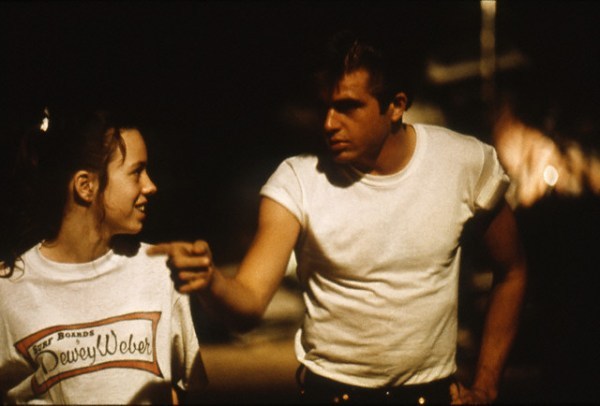
"American Graffiti"
Released in 1973
Takes place in 1962
11 year setback


JFNC exceeded in 1984


You want my advice? Give up.


“Grease,”
Released in 1978  
Takes place in 1959 
19 year setback


JFNC exceeded in 1997


Scariest TV dad ever.
"The Wonder Years"
Released in 1988
Takes place in 1968
20 year setback


JFNC exceeded in 2008


Calm the fuck down, Kiefer Sutherland.
“Stand by Me”
Released in 1986
Takes place in 1960
26 year setback


JFNC exceeded in 2012


I can't believe the Houndmouth show sold out. 
“Paper Moon”
Released in 1973
Takes place in 1933
40 year setback


JFNC exceeded in 2013!  


That's now!  What does this mean!? Can this explain our pop charts' currently inexhaustible supply of dust-bowl fetishizing bullshit?! Are we suffering through flavor-of-the-minute, bros-with-banjos malarkey because the we've simply run the gestation period for an era's aesthetic to turn from the stuff of wistful fictioning to blatant, undergrad imitation without a hint of embarrassment?  

Well, probably not. On the whole, our culture is masturbating concurrently to too many eras past for any coherent mechanism to fully model the sadness, but I think we're getting closer.  
Also, with a 40 year jump back in time, "Paper Moon" is more historic fiction than nostalgia mining, but whatever. I should also probably also mention at this time that I'm making a convenient assumption to get a specific year for the film's setting. Although our heroes do spend a good part of the second act tooling around in a 1936 Ford Phaeton, I consider the moonshine-running subplot a bit more important for placing a "real" point in this impossible timeline, so we'll go with the last year of prohibition. And herein lies a problem.


As is the case with any truly excellent storytelling, the reality that the characters inhabit feels totally convincing, even though the smallest amount of scrutiny turns up glaring problems with that reality.  When Roger Ebert reviewed "American Graffiti," he said that no sociological treatise could duplicate the movie's success in remembering exactly how it was to be alive at that cultural instant.  Which is true for all I know, (and possibly not that impressive since it was only time traveling 11 years) but I have mixed feelings about fictional works of pure entertainment (that were from the outset distorted in the rear-view mirror) getting that kind of veneration and authority.   It seems like a great way for careless anachronism to become actual canon and nostalgic onanism to become historic record.
But maybe that's not why I'm suddenly so irritated by our obsession with the good ol' days. I think I'm deeply bothered by the fact that “The Sandlot,” is an irreplaceable, defining piece of the childhood of myself and millions of other people who have no business defining their childhoods around anything based in 1962. Wistfulness might be as certain as death and the collapse of Social Security, but it might be nice to at least have our own fucking nostalgia and not have to borrow our parents.'

Obviously, the prospects of the world we've inherited are limited to picking through its bones, but I feel that if this generation has a leg up on the boomers in any respect, maybe it's this: a well-earned aversion to rose-colored revisionism (and a smug sense of superiority). Specifically, if a movie came out today that was the chronological analogue to "American Graffiti," taking place 11 years ago, the time of my own high school graduation, there's no way I could watch it thinking, "Man, 2002 was fucking great."  Because it wasn't. And I'll wager dollars to donuts that 1962 wasn't either.


One of my all time favorite movie scenes is from John Carpenter’s 1983 adaptation of Stephen King’s “Christine.”  I don’t know if it was meant to be a brilliant visual metaphor for the impossible task of finally crushing and destroying boomer nostalgia, but it's hard for me to read it any other way these days. Because just when you think we've finally killed this post-war American age of innocence thing, Spielberg decides to do "Indiana Jones 4", or "Grease" is back on Broadway again.